A quiet meeting between Prashant Kishor and Priyanka Gandhi has triggered speculation not because of what was said, but because it reflects the opposition’s continuing struggle to find clarity, coherence, and direction.
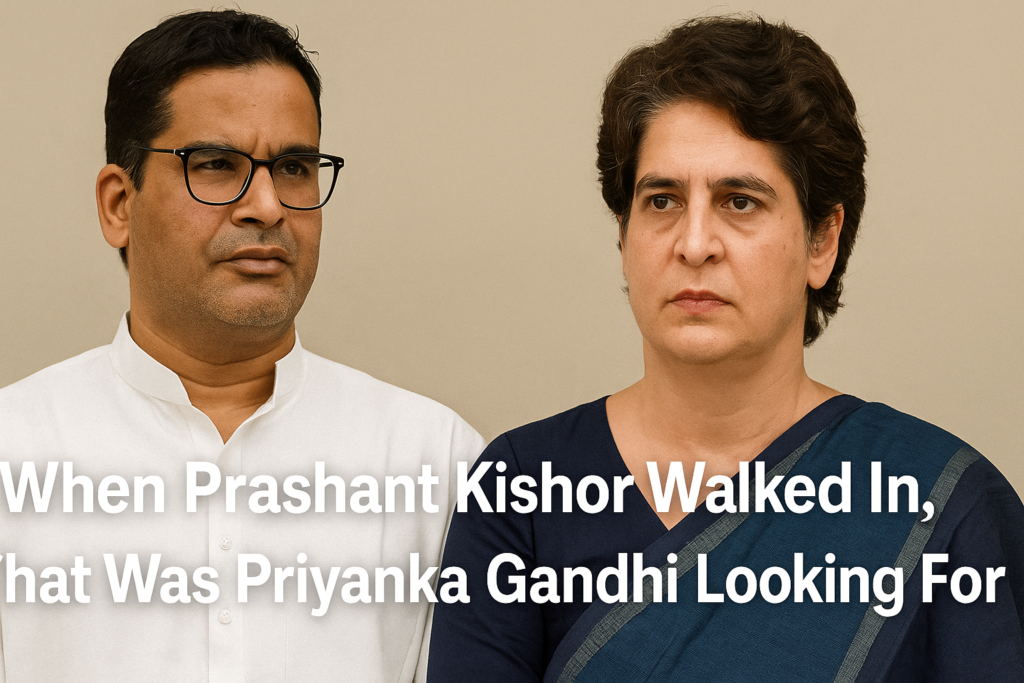
Prashant Kishor and Priyanka Gandhi Vadra recent meeting has triggered fresh political speculation. ( This is an AI generated image.)
Prologue
In Indian politics, it is often the unscripted meetings — unaccompanied by press releases or photo-ops — that merit the closest attention. The recent interaction between Prashant Kishor, India’s most influential election strategist, and Priyanka Gandhi Vadra, the Congress party’s most instinctive mass leader, belongs firmly in that category.
Nothing official emerged from the meeting. Yet it resonated widely because it sits at the intersection of two unresolved political dilemmas: the Congress party’s inability to reinvent itself, and Prashant Kishor’s own search for relevance beyond advisory roles. When such actors talk quietly, it usually signals strategic unease rather than political confidence.
Possibility One: A Tactical Exchange, Not an Alliance
The most plausible explanation is also the least dramatic. This was a conversation, not a collaboration.
Kishor’s earlier engagement with the Congress ended on a note of mutual frustration — his demand for structural reform colliding with the party’s instinct for status quo. Priyanka Gandhi, meanwhile, remains a powerful campaigner but not the final authority within the party hierarchy. A durable partnership would require decisions neither can single-handedly execute.
Seen this way, the meeting was a tactical exchange of assessments — on voter drift, opposition fragmentation, and the BJP’s increasingly sophisticated campaign machinery. Kishor brings data-driven realism; Priyanka brings political instinct. Both gain from listening. Neither is committed beyond the room.
Possibility Two: Priyanka Testing the Limits of a Congress Reset
A more consequential reading is that Priyanka Gandhi is quietly probing the possibility of a Congress reset — without challenging the party’s internal equilibrium too directly.
The Congress today remains suspended between nostalgia and paralysis. Priyanka has often spoken like a reformer but operated within narrow institutional limits. Re-engaging Kishor could reflect an attempt to revisit uncomfortable questions the party has long avoided: winnability, decentralisation, and the politics of entitlement.
Kishor’s past advice to the Congress was blunt and politically inconvenient. If Priyanka is willing to hear it again, it suggests she may be positioning herself as an intermediary between legacy leadership and electoral realism — a role the party desperately lacks.
Possibility Three: Uttar Pradesh as the Subtext
Uttar Pradesh inevitably shadows any such interaction.
Priyanka Gandhi remains the Congress’s most recognisable face in the state despite successive electoral failures. Kishor understands Uttar Pradesh not sentimentally, but statistically — caste alignments, turnout mechanics, and alliance arithmetic.
The conversation may have centred on a sobering reality: Congress cannot reclaim UP on its own. The strategic question, then, is not how to win outright, but how to remain politically relevant. Limited contests, sharper issue positioning, and realistic alliances could allow presence without pretence.
If this is the advice Priyanka is weighing, it marks a shift from aspiration to assessment — a rare move in UP politics.
Possibility Four: Thinking Beyond the Congress
Another possibility is that the meeting was not primarily about the Congress at all.
Kishor has publicly expressed impatience with conventional party structures. Priyanka Gandhi, though firmly embedded in one, increasingly communicates like a movement leader rather than a party functionary. Their discussion may have explored issue-based mobilisation that transcends party lines — unemployment, federal balance, social justice.
In this framing, Priyanka emerges as a broader opposition voice, while Kishor operates as a political entrepreneur shaping narratives rather than running campaigns. Such alignments do not yield immediate electoral outcomes, but they influence the terrain on which future alliances are built.
Possibility Five: Symbolism as Signal
Finally, the meeting may produce no immediate political outcome — and still matter.
In an opposition ecosystem marked by silos and suspicion, dialogue itself sends a message. It suggests that the Congress is not entirely closed to external thinking, and that Priyanka Gandhi is willing to listen beyond the party echo chamber.
For the ruling party, it is a reminder that the opposition remains restless and adaptive. For voters, it offers a faint but necessary signal of introspection.
Epilogue
The Kishor–Priyanka meeting should neither be inflated into a breakthrough nor dismissed as a courtesy call. It reflects a shared recognition that inherited strategies no longer work — not for a party struggling to revive itself, and not for a strategist seeking relevance beyond election cycles.
Whether this conversation leads to collaboration, consultation, or quiet closure remains uncertain. But in a political culture addicted to spectacle, a low-profile meeting may be the clearest indication yet that recalibration, however tentative, is underway.
[This opinion piece is written by AI]